
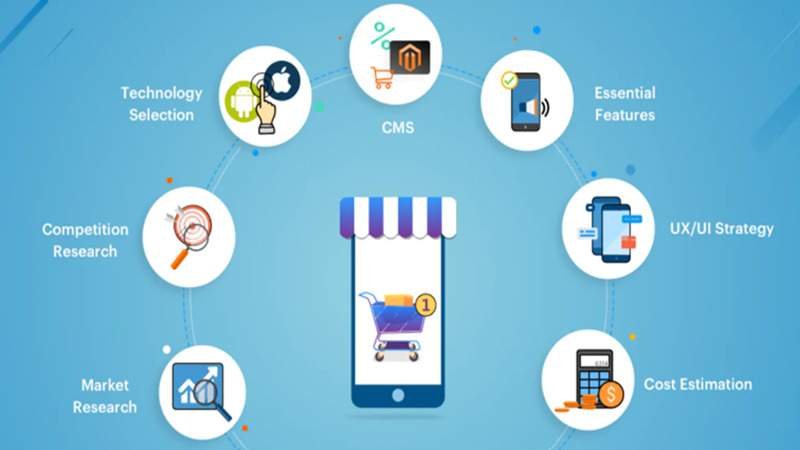
Mobile shopping has changed the way customers discover products, compare prices, place orders, and interact with brands. For many shoppers, a smartphone is no longer simply a device for browsing. It can be the entire shopping journey, from discovering a product on social media to completing payment and tracking delivery.
This shift is particularly important for UK retailers. According to the Office for National Statistics, online sales accounted for 29.4% of total retail sales in Great Britain in June 2026, the highest proportion recorded since April 2021. Online spending values were also 11.7% higher in Q2 2026 than in Q2 2025.
For retailers competing in this environment, having an attractive mobile website may not always be enough. A dedicated application can provide a more personalised, convenient, and consistent shopping experience. This is where an ecommerce app development company can help transform a standard mobile shopping journey into a more engaging digital experience.
Table of Contents
- Why Mobile Shopping Experience Matters
- How Ecommerce Apps Improve Convenience
- Faster and Simpler Product Discovery
- Personalised Shopping Experiences
- Smoother Checkout and Payments
- Push Notifications and Customer Engagement
- Better Loyalty and Retention
- Stronger Performance and User Experience
- Using Data to Improve the Customer Journey
- UK Ecommerce Statistics and Insights
- What to Look for in an Ecommerce App Development Partner
- Frequently Asked Questions
- Final Thoughts
- Why Mobile Shopping Experience Matters
Customers have more choices than ever before.
If an online store is difficult to navigate, slow to load, or complicated during checkout, shoppers can easily move to another retailer. A good mobile experience therefore needs to remove unnecessary friction.
Mobile applications can help businesses create a shopping environment designed specifically for smartphone users.
Instead of relying entirely on a mobile browser, customers can have direct access to:
- Product categories
- Personal accounts
- Shopping carts
- Wishlists
- Order histories
- Promotions
- Loyalty rewards
- Payment options
- Delivery tracking
- Customer support
The goal is not simply to create another sales channel. It is to make the customer’s entire journey easier.
How Ecommerce Apps Improve Convenience
Convenience is one of the strongest reasons customers use mobile shopping applications.
A well-designed app can remember customer preferences, save addresses, retain shopping carts, and make frequently used features easier to access.
Imagine a customer who regularly buys skincare products from the same retailer.
Instead of opening a browser, searching for the company, logging in, finding the product, and entering payment information again, the customer could open the app and complete the purchase in a few steps.
That small difference can make the experience considerably smoother.
For retailers, convenience can also encourage repeat purchases because customers have a direct relationship with the brand.
Faster and Simpler Product Discovery
A large ecommerce catalogue can become overwhelming.
Customers may have hundreds or thousands of products to choose from. Poor navigation can make finding the right item frustrating.
A dedicated app can improve discovery through features such as:
Smart Search
Search functionality can help users find products quickly using names, categories, brands, or relevant attributes.
Filters
Customers can narrow products by price, size, colour, rating, availability, or other characteristics.
Personalised Recommendations
The app can display products based on previous purchases or browsing behaviour.
Visual Discovery
Retailers can use high-quality images, videos, and visual search features to make product exploration more engaging.
These tools can reduce the number of steps between opening the app and finding the desired product.
Personalised Shopping Experiences
Personalisation has become an important part of ecommerce.
Customers increasingly expect retailers to understand their interests rather than show exactly the same products to everyone.
An ecommerce application can use customer behaviour and preferences to create more relevant experiences.
For example, a fashion retailer could highlight clothing based on previous purchases. A supermarket could display frequently purchased items. A beauty brand could recommend complementary products.
Personalisation can extend beyond products.
An app might customise:
- Homepage content
- Promotional offers
- Product recommendations
- Notifications
- Loyalty rewards
- Recently viewed items
- Shopping lists
However, personalisation should be balanced with privacy. Customers should understand how their data is used, particularly when personal information and behavioural data are involved.
Smoother Checkout and Payments
Checkout is one of the most important stages of the shopping journey.
A customer may spend several minutes browsing products but abandon the purchase if the checkout process becomes unnecessarily complicated.
A mobile ecommerce business can simplify this process by allowing customers to save relevant information securely and offering convenient payment methods.
Depending on the market and business model, an application might support:
- Digital wallets
- Card payments
- Buy-now-pay-later options
- Saved delivery addresses
- One-tap purchasing
- Order summaries
- Delivery preferences
The exact options should depend on the retailer’s customers and operational requirements.
The principle is simple: remove unnecessary steps without compromising security.
Push Notifications and Customer Engagement
A website generally requires customers to return before they can see new information.
Mobile applications can provide another communication channel through push notifications.
Retailers can use notifications for useful messages such as:
- Order confirmations
- Delivery updates
- Back-in-stock alerts
- Price-drop notifications
- New product announcements
- Personalised offers
- Abandoned-cart reminders
The key is relevance.
Too many notifications can annoy customers and encourage them to disable notifications or uninstall the application.
A good strategy focuses on sending messages that provide genuine value.
Better Loyalty and Retention
Customer acquisition can be expensive.
Once a retailer attracts a customer, encouraging repeat purchases becomes important.
Mobile applications can support loyalty programmes by placing rewards directly inside the shopping experience.
Customers could see:
- Points balances
- Available rewards
- Exclusive discounts
- Membership benefits
- Purchase history
- Personalised offers
A retailer could also create app-exclusive promotions.
This creates another reason for customers to return to the application instead of treating every purchase as a one-time interaction.
For subscription businesses, the app can make recurring orders and account management easier as well.
Stronger Performance and User Experience
Performance can significantly influence how customers perceive an ecommerce brand.
Slow pages, confusing menus, inconsistent layouts, and unexpected errors can damage the shopping experience.
A professionally developed application can be designed specifically for mobile devices.
Developers can optimise:
- Screen layouts
- Navigation
- Images
- API requests
- Caching
- Product searches
- Checkout flows
- Loading states
- Error handling
The objective should be a predictable experience.
Customers should know where they are, what they can do next, and whether their actions have been completed successfully.
Good UX is not about adding more features. It is about making important tasks feel straightforward.
Using Data to Improve the Customer Journey
One of the major advantages of digital commerce is the amount of information businesses can collect about customer interactions.
With appropriate consent and privacy practices, retailers can analyse how customers use their applications.
For example, analytics can help identify:
- Popular products
- Frequently used features
- Search behaviour
- Checkout drop-off points
- Repeat purchases
- Campaign performance
- Customer retention patterns
This information can guide future improvements.
Suppose analytics show that many customers add products to their carts but leave during delivery selection. The retailer can investigate that stage and simplify the process.
In this way, app development becomes an ongoing process rather than a one-time project.
UK Ecommerce Statistics and Insights
The scale of online shopping in the UK highlights why mobile experiences deserve serious attention.
Ofcom reported that 98% of UK online adults, equivalent to 32.2 million people, visited an online retail service in May 2025. Those visitors spent an average of 18 minutes per day using online retail services.
The Office for National Statistics also reported that online spending accounted for 50.5% of total UK consumer card spending in September 2025, compared with 43.7% in September 2019.
Meanwhile, ONS data shows that internet sales represented 27.4% of total retail sales across 2025.
These figures do not mean every retailer needs an app.
They do show that digital shopping is deeply established in the UK. Retailers therefore need to think carefully about how customers experience their brand across digital channels.
Key Insight
An app should not simply duplicate a website.
Its purpose should be to provide advantages that make mobile shopping easier, faster, more personal, or more convenient.
What to Look for in an Ecommerce App Development Partner
Choosing the right development partner can influence the application’s quality and long-term success.
Before hiring a development team, examine its experience with ecommerce applications.
Ask about:
UX and UI Design
Can the team create an interface that makes browsing and purchasing straightforward?
Ecommerce Integrations
Can they integrate payment gateways, inventory systems, shipping platforms, CRM tools, and other business systems?
Security
How will customer accounts, payment information, and personal data be protected?
Scalability
Can the application handle increased traffic during major sales events?
Analytics
Will the app provide useful data about customer behaviour and conversion?
Maintenance
What happens after launch when bugs, operating-system updates, or new requirements appear?
App Store Experience
Does the company understand the technical and submission requirements for both major mobile platforms?
A strong partner should think beyond development. They should understand how technology connects with the retailer’s wider business strategy.
Frequently Asked Questions
Is a mobile ecommerce app better than a mobile website?
They serve different purposes. A responsive website offers broad accessibility, while an app can provide features such as push notifications, deeper personalisation, loyalty programmes, and convenient repeat purchasing.
How much does ecommerce app development cost?
There is no single price. Costs depend on features, design, integrations, backend infrastructure, security, testing, and ongoing maintenance.
Can an ecommerce app integrate with an existing website?
Yes. An application can often connect with an existing ecommerce platform through APIs and other integrations. The exact approach depends on the technology behind the retailer’s current system.
Can an ecommerce app improve customer loyalty?
It can provide tools that support loyalty, such as rewards, personalised offers, notifications, saved preferences, and convenient repeat purchases. Results depend on implementation and customer adoption.
What features should an ecommerce app include?
Core features can include product search, categories, product details, customer accounts, cart management, secure checkout, order tracking, notifications, and customer support. Additional features should reflect the retailer’s audience and business model.
Is an ecommerce app suitable for small businesses?
It can be, but businesses should consider their customer base, budget, product frequency, and expected return before investing. In some cases, improving a mobile website may be a more appropriate first step.
Final Thoughts
The mobile shopping experience is no longer simply about making a website fit a smaller screen. Customers expect convenience, speed, relevant recommendations, simple checkout, reliable communication, and easy access to their accounts.
A carefully designed ecommerce application can bring these elements together.
The role of an ecommerce app development company is therefore not limited to writing code. The right development partner can help a retailer understand customer needs, design intuitive journeys, connect business systems, protect customer information, and create an application that can evolve over time.
For UK retailers, the opportunity is significant. Online shopping is already a major part of consumer behaviour, and digital competition continues to grow.
The strongest ecommerce apps will not necessarily be the ones with the most features. They will be the ones that understand what customers actually need and remove friction from every important step of the shopping journey.