
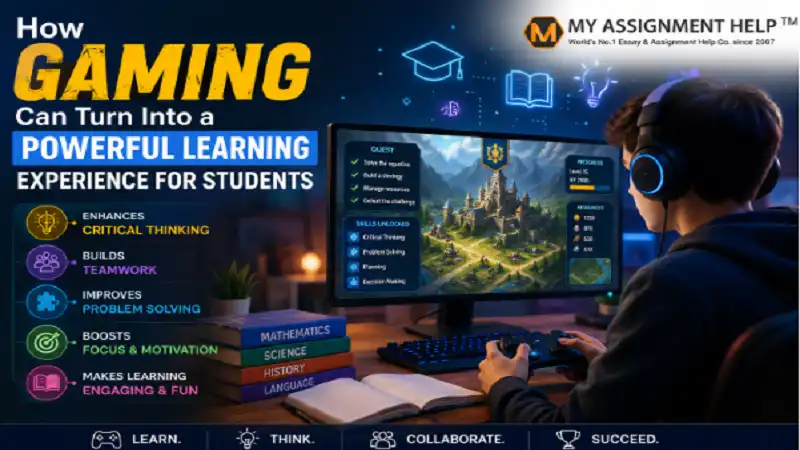
Gaming is often viewed as a source of entertainment, relaxation, and friendly competition. However, the modern gaming experience can offer much more than a temporary escape from academic routines. When thoughtfully selected and used with the right purpose, games can encourage students to think critically, solve problems, communicate with others, and learn from mistakes. The growing interest in game-based learning reflects a broader shift toward interactive education, where students participate actively rather than simply receive information.
Students today are also searching for ways to balance assignments, examinations, personal interests, and digital activities. When academic pressure becomes overwhelming, some may search online for services that promise to make my assignment easier or faster. Yet gaming can provide another kind of support: it can help students develop the thinking and organisational skills they need to approach academic challenges with greater confidence. Instead of replacing education, well-designed gaming experiences can complement traditional learning and make certain skills easier to practise.
What Is Game-Based Learning?
Game-based learning refers to the use of games or game-like experiences to support a specific learning objective. It is different from simply allowing students to play games during free time. In game-based learning, the activity has an educational purpose. Students might solve puzzles to practise mathematics, manage resources to understand economics, explore virtual environments to study history, or work with teammates to develop communication skills.
Learning Through Interaction
Traditional learning can sometimes involve listening to a lecture, reading a textbook, or memorising information. Games introduce another dimension: interaction. Students make choices, observe consequences, adjust their approach, and try again.
This creates an environment where learning becomes an active process. Instead of asking students to remember a concept without context, a game can place them in a situation where they have to apply that concept.
Research supports the potential of this approach. A meta-analysis examining 20 empirical studies involving 1,947 participants found an overall positive effect of game-based learning on students’ critical thinking, although the results varied according to different conditions and game types.
Why Gaming Can Make Learning More Engaging
One of the strongest advantages of games is their ability to capture attention. A well-designed game provides a goal, a challenge, feedback, and a reason to continue.
Students Become Active Participants
In a conventional classroom activity, students may sometimes feel that they are simply completing instructions. In a game, their decisions directly influence what happens next.
For example, a strategy game may require a player to decide how to distribute limited resources. A puzzle game may require several attempts before the correct solution becomes clear. A team-based challenge may require players to communicate before making a decision.
These experiences encourage students to participate rather than passively observe.
Immediate Feedback Encourages Improvement
Games normally provide some form of feedback. A player may succeed, fail, lose points, unlock a new level, or discover that a particular strategy does not work.
This can create an important learning cycle:
Attempt → Result → Reflection → Adjustment → Another Attempt
The same cycle is valuable in education. Students rarely understand every concept perfectly on their first attempt. Learning improves when they can identify an error, understand why it happened, and try a different approach.
Gaming Can Strengthen Critical Thinking
Critical thinking is one of the most valuable abilities students can develop. It involves examining information, comparing possibilities, identifying patterns, questioning assumptions, and reaching reasoned conclusions.
Strategy Games Encourage Planning
Strategy-based games often require players to think several steps ahead. A decision that appears beneficial immediately may create a problem later.
Students can learn to ask questions such as:
- What could happen if I choose this option?
- What information am I missing?
- Is there another way to solve the problem?
- What are the risks of this decision?
- Which option gives me the strongest long-term result?
These questions are not limited to gaming. They are also relevant when students conduct research, analyse case studies, complete projects, or prepare arguments.
Games Make Problem-Solving Practical
A textbook can explain the principles of problem-solving, but games allow students to practise those principles.
Suppose a player encounters an obstacle that prevents progress. They must identify the problem, examine available resources, test possible solutions, and learn from unsuccessful attempts. The process resembles real-world problem-solving more closely than simply memorising a definition.
This is one reason game-based learning can be particularly useful when the objective is to develop thinking skills rather than only factual knowledge.
How Gaming Develops Decision-Making Skills
Students make decisions every day. They decide how to organise their study time, which information to trust, how to approach an assignment, and how to work with classmates.
Games can provide a controlled environment in which decision-making has visible consequences.
Learning From Consequences
When students make a poor decision in a game, they can often see what happened as a result. This creates an opportunity to reconsider the original choice.
For instance, a player may spend resources too quickly and later discover that they do not have enough to complete an objective. The experience teaches the importance of planning and resource management without requiring a lengthy theoretical explanation.
The same principle applies to educational simulations. Students can experiment with decisions and observe outcomes without facing the real-world consequences associated with those decisions.
Gaming Can Improve Teamwork and Communication
Not every valuable educational skill is academic. Communication, collaboration, leadership, patience, and cooperation are increasingly important in education and professional life.
Multiplayer games can create situations in which players must work together to achieve a shared goal.
Collaboration Requires Clear Communication
Team-based gaming often requires players to explain their ideas quickly and listen to others. A team member may need to suggest a strategy, warn others about a potential problem, or coordinate an action.
Students can transfer these habits into group assignments and classroom projects. They learn that successful teamwork is not simply about having intelligent individuals in the same group. It requires communication and a willingness to consider different perspectives.
Leadership Can Develop Naturally
Games can also provide opportunities for leadership. Someone may take responsibility for organising a team, explaining a strategy, or helping less experienced players.
These experiences can help students understand that leadership is not always about giving instructions. Good leadership can involve listening, adapting, encouraging others, and making decisions when necessary.
Gaming Can Teach Students to Handle Failure
Failure is an important part of learning, but students sometimes become afraid of making mistakes. Gaming can change the way failure is perceived.
Mistakes Become Part of the Process
In many games, losing a round does not mean the player has failed permanently. They can analyse what happened and try again.
This encourages a growth-oriented attitude. Instead of thinking, “I cannot do this,” a student may begin thinking, “My previous approach did not work, so I need to try something different.”
That mindset can be useful in academic life. A disappointing test result or unsuccessful assignment does not have to define a student’s ability. It can become information that helps them identify where improvement is needed.
The Connection Between Gaming and Academic Skills
Gaming does not automatically make someone a better student. The educational value depends heavily on the type of game, how it is used, and whether the student reflects on the experience.
Reading and Following Instructions
Many games contain detailed instructions, objectives, character descriptions, rules, and strategic information. Players need to read and understand this material before they can perform effectively.
This can encourage practical reading comprehension.
Mathematics and Resource Management
Strategy and simulation games frequently involve numbers, probability, budgets, scores, timing, measurements, or resource allocation. Players may use mathematical thinking without necessarily experiencing it as a conventional mathematics exercise.
Creativity and Exploration
Games that allow players to build, design, customise, or experiment can encourage creativity. Students can explore different approaches rather than following one predetermined path.
Creative thinking is particularly useful in subjects where there may be multiple valid solutions to a problem.
Gaming Should Complement Academic Work
It is important to recognise that gaming should not become a replacement for studying. Students still need to read academic materials, attend classes, conduct research, write assignments, and prepare for examinations.
Around the middle of an academic workload, students may encounter online advertisements or services encouraging them to buy college essay content or outsource their academic work. While such shortcuts may appear convenient, students gain more long-term value when they develop the skills themselves. Educational gaming can contribute to that development by giving students additional opportunities to practise reasoning, planning, communication, and problem-solving.
The goal should not be to choose gaming instead of education. The better approach is to understand how gaming can become one tool within a broader learning strategy.
How Students Can Use Gaming More Productively
Students can make their gaming experiences more educational by becoming intentional about what they play and what they learn from it.
Choose Games That Encourage Thinking
Games based on strategy, puzzles, simulations, construction, exploration, and collaboration can provide more opportunities for cognitive and social development than games that rely primarily on repetitive actions.
This does not mean entertainment-focused games have no value. It simply means that students should recognise the different skills different games encourage.
Reflect After Playing
Reflection can turn an ordinary gaming session into a learning opportunity.
Students can ask:
- What strategy worked?
- What mistake did I make?
- Why did my first approach fail?
- How did another player solve the problem?
- What would I do differently next time?
These questions encourage students to connect gameplay with broader learning habits.
Set Healthy Boundaries
Gaming can be beneficial when it is balanced. Excessive gaming can interfere with sleep, study, physical activity, relationships, and other responsibilities.
A productive approach is to create clear boundaries. Students can complete important academic responsibilities first and then use gaming as a controlled recreational or learning activity.
The Role of Teachers in Game-Based Learning
Teachers can play an important role in transforming games from entertainment into meaningful educational experiences.
Connecting Games With Curriculum
A teacher can introduce a game alongside a lesson and then ask students to connect what happened in the game with a curriculum concept.
For example, a business simulation could lead to a discussion about supply and demand. A historical simulation could encourage students to examine different perspectives on a particular event. A strategy challenge could be followed by a lesson about decision-making.
Encouraging Discussion
The educational value does not necessarily end when the game ends. Teachers can ask students to discuss their decisions, compare strategies, and explain why certain approaches worked.
This transforms gameplay into a starting point for deeper conversation.
The Future of Gaming and Education
Technology continues to change the way students learn. Digital games, simulations, virtual environments, and interactive platforms are creating new possibilities for experiential education.
Research into educational games has also expanded beyond simple entertainment. Studies have examined their effects on motivation, knowledge acquisition, critical thinking, collaboration, and technical learning. Recent research in areas such as robotics education is also exploring how game-based approaches can support computational thinking and problem-solving.
The future may therefore involve classrooms where traditional teaching and interactive experiences work together rather than existing as completely separate approaches.
Final Thoughts
Gaming has the potential to become much more than a recreational activity. When selected carefully and connected to meaningful objectives, it can create opportunities for students to practise critical thinking, decision-making, communication, creativity, problem-solving, and resilience.
The most important point is that the educational value of gaming does not come simply from pressing buttons or completing levels. It comes from the thinking that happens during the experience. Students analyse situations, make choices, experience consequences, adapt strategies, and learn from mistakes.
That makes gaming particularly interesting as an educational tool. It can provide a space where learning feels active, challenging, and rewarding.
For students, the best approach is balance. Gaming should support academic development rather than replace genuine study. When combined with classroom learning, independent research, reading, writing, and responsible study habits, gaming can become a powerful addition to the modern learning experience.
The future of education may not be about choosing between books and technology, classrooms and digital platforms, or studying and playing. Instead, it may be about finding thoughtful ways to bring these experiences together so students can learn by doing, experimenting, collaborating, and thinking.
Frequently Asked Questions
1. How can gaming support student learning?
Gaming can support learning by encouraging students to practise problem-solving, critical thinking, decision-making, creativity, and strategic planning. Interactive challenges can make learning more engaging and give students opportunities to apply concepts rather than simply memorising them.
2. Can strategy games improve critical thinking skills?
Yes. Strategy games often require players to analyse situations, consider different options, predict outcomes, and develop plans. These activities can help students strengthen critical-thinking skills that are useful in academic work and everyday decision-making.
3. Can gaming help students develop teamwork skills?
Yes. Multiplayer and team-based games can encourage communication, cooperation, leadership, and coordination. Students learn to share ideas, listen to teammates, divide responsibilities, and work toward a common objective.
4. Is gaming a replacement for traditional studying?
No. Gaming should complement, rather than replace, traditional education. Students still need to read, research, attend classes, complete coursework, and prepare for examinations. Educational gaming can provide an additional interactive way to practise useful skills.
5. How can students make gaming a productive learning activity?
Students can choose games that involve strategy, puzzles, simulations, creativity, or collaboration. They can also reflect on the decisions they made, mistakes they encountered, and strategies that worked. Setting reasonable gaming limits can help maintain a healthy balance between gaming, studying, and other responsibilities.