
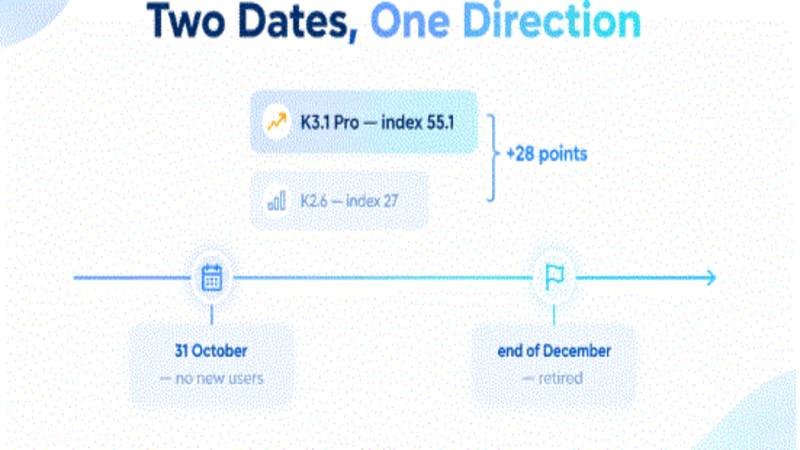
Moonshot’s pricing page carries a notice that most coverage of Kimi K3.1 Pro did not mention: starting 31 October 2026, K2 series models are no longer available to newly registered users, and all K2 series models are scheduled for retirement by the end of December 2026 [VENDOR]. Existing users are unaffected until the retirement date. That gives teams running Kimi K2.5, K2.6 or K2.7 Code a decision with a deadline rather than a preference — and the intended destination, OrcaRouter‘s Kimi K3.1, is a very different model on every axis that matters, including price.
This is not a routine deprecation notice. The generation gap here is the widest in the Kimi line: 27.0 on the independent index for K2.6 against 55.09 for K3.1 Pro — 28 points, roughly the distance between a small model and the fourth-best model in the field [INDEPENDENT / OURS card, 26 October]. A migration that closes 28 points is worth planning properly, and a migration that also changes the price by 2.1× on input and 2.5× on output is worth planning financially.
The two generations, side by side
| Kimi K2.6 | Kimi K2.7 Code | Kimi K3.1 Pro | |
| AA Intelligence Index | 27.0 | 25.81 | 55.09 |
| Input / output per 1M | $0.95 / $4.00 | $0.95 / $4.00 | $2.00 / $10.00 |
| Cache read | $0.16 | $0.19 | $0.20 |
| Context | 262,144 | 262,144 | 1,048,576 |
| Output speed (ours) | 142.9 tok/s | 59.6 tok/s | 52.4 tok/s |
| p50 (ours) | 5,989 ms | 3,390 ms | 6,752 ms |
| 7-day tokens (ours) | 107.9M | 45.4M | 1,305.4M |
The first three rows are the migration argument. The last three are the migration problem.
What gets better
Capability, by 28 points. That is not a matter of taste; it is the difference between a model that fails hard tasks and one that is fourth in the field. If K2.6 was a stopgap, the stopgap has been replaced by something in a different class.
Context, by 4×. 262,144 to 1,048,576. Any chunking pipeline built around 256K can be simplified, and long-context work that was impossible becomes ordinary.
Terminal and agentic behaviour. K2.7 Code scores 25.81 overall; K3.1 Pro scores 67.17% on Terminal-Bench 4.0 against the K2 generation’s far weaker showing. If your K2 workload was an agent, this is the biggest single gain in the migration.
What gets worse
Price. Input goes from $0.95 to $2.00 (2.1×), output from $4.00 to $10.00 (2.5×). For a high-volume pipeline on K2.6, the same traffic on K3.1 Pro costs roughly two and a half times as much before any token-count change — and the model writes more, because thinking is always on and defaults to `max` [VENDOR].
Throughput. K2.6 runs at 142.9 output tokens per second on our route; K3.1 Pro runs at 52.4. K2.7 Code is faster still than K3.1 Pro at 3,390 ms to first token against 6,752. If your workload is latency-sensitive or throughput-bound, the newer model is a downgrade in the dimension you care about.
The cheap mode disappears. K2 generation models can answer without long deliberation. Kimi K3.1 Pro always thinks, with `reasoning_effort` at `low`, `high` or `max` and `max` as the default. There is no equivalent of “just classify this string” — the closest you get is `low` effort plus a small `max_completion_tokens`. For teams on K2.7 Code, that makes the real question not whether to migrate but what to keep on a small, fast coder, because always-on reasoning turns a two-second completion into a six-second one.
The migration map
K2.6 → K3.1 Pro for capability work, but not for volume. Analysis, coding, long documents and agents all belong on the new model. High-volume extraction and classification do not: 2.5× the price and a mandatory thinking budget make a simple task expensive on a big model.
K2.7 Code → K3.1 Pro where the work is terminal-shaped. K2.7 Code is a specialist coder at 25.81 overall. For agentic terminal work, K3.1 Pro’s 67.17% is a different category. For short, high-frequency code completions, K2.7 Code’s 3.39-second p50 remains better than anything the new model offers.
Anything on K2.5 → off the line entirely. K2.5 shows zero traffic on our route over seven days, and its latency rows are empty because there is nothing to measure. That is what a model nobody calls looks like.
Keep a cheap sibling for the traffic you cannot afford to move. The right answer for most K2 users is not “everything to K3.1 Pro”. It is “K3.1 Pro for the hard half, and a cheap fast model from another vendor or a smaller Kimi for the easy half”. That is a routing decision, and it is cheaper than the price difference.
A four-week plan
Week one: classify your traffic. Count requests by prompt length, output length and whether tools are involved. Most K2 traffic splits cleanly into a large easy half and a small hard half, and only the hard half belongs on the new model.
Week two: migrate the hard half. Change the model string, delete the sampling parameters (K3.1 Pro refuses `temperature`, `top_p` and the penalties), set `max_completion_tokens` explicitly, and choose an effort level per workload. Then run your regression set and record cost per completed task, not per token.
Week three: re-point the easy half. If your tooling routes through one gateway, this is a policy change rather than an integration.
Week four: decommission. With the end-of-December retirement in view, remove the K2 model strings and any configuration that assumes a 262,144-token window. A pipeline that silently depends on the old context size is the failure mode that shows up in January.
What to watch for
The 31 October date is about new users, not about you. If you are already on K2 with Moonshot directly, nothing breaks on Friday. If you are provisioning a new environment, K2 is already unavailable, which is why the decision has effectively been made for any new deployment.
The retirement date is the hard one. End of December 2026 is a holiday-adjacent deadline for most engineering organisations. Teams that plan in January will be migrating in an outage window.
The price increase is not the vendor’s only lever. K3.1 Pro launched a third cheaper than Kimi K3 on every billed line [VENDOR], so the K2-to-K3.1 jump is a jump from a budget tier to a mid tier, not a price hike on the same product. Framing it that way makes the routing decision obvious: buy the capability where you need it, and use a cheaper model where you do not.
Sourcing note: the 31 October restriction, the end-of-December retirement and the K2 series’ 262,144-token context are Moonshot’s pricing page, fetched 26 October 2026. Rate cards, context windows, reasoning defaults and the K2.7 Code index score are Moonshot’s or Artificial Analysis’s as labelled; K2.6’s 27.0 is the figure our own card carries, and AA’s live leaderboard no longer lists a scored entry for it. Throughput, p50 and seven-day token volumes are OrcaRouter’s own routing telemetry for the window ending 26 October 2026. The migration plan and the routing recommendation are ours.